
Where to look up a BAR membership number, a company’s filing history, an insurance certificate, a VAT number and a depot address — and what a real answer looks like.

If you want to check a removal company is legitimate, you do not need instinct or a checklist of vibes. Almost every claim a remover makes about itself is verifiable against a public register, usually free, usually in under a minute. A membership number can be looked up. A company can be searched at Companies House. A VAT number can be validated on a government service. An insurance certificate can be read properly and, if you want to go further, confirmed with the broker named on it. A depot address either exists or it does not.
This page is the practical version of that. It is written by a BAR-registered family remover in Sussex, so our interest is obvious — but the checks below apply to us exactly as they apply to anyone else, and we would rather you ran them. If you want the wider due-diligence picture, our guide to avoiding moving scams covers the red flags to watch for; if you want to know how the specific frauds are constructed, read the moving scam playbooks. What follows here is narrower and more useful: exactly where to look, exactly what you should see, and what it means when the answer does not match.
A BAR logo on a website is a picture. It proves nothing on its own, and putting one there costs a rogue operator nothing at all. What you are verifying is not the logo but the membership itself.
Ask the firm for its membership number and the exact name it is registered under — the second part matters, because members are listed under their legal or registered trading name, which is not always the name on the van. Then search the member directory on the British Association of Removers’ own website at bar.co.uk rather than following a link from the remover’s site. If a firm is a member, it will appear. If it does not appear, the membership is either lapsed, never existed, or belongs to a different company with a similar name.
Two things trip people up. The first is companies describing themselves as “BAR approved”, “working to BAR standards” or “a member of a BAR-affiliated network”. None of those are membership. Membership is binary and it is searchable. The second is confusing membership categories. Full membership involves an annual audit of the business and access to the Advance Payment Guarantee, which is what protects your deposit if the company fails. Overseas Group membership is a separate specialism for international work. If overseas removals are involved, check for both, and check separately whether the firm actually holds the BS 8564 international removals standard rather than simply mentioning it.
The same discipline applies to every other logo in a website footer. Any trade body worth quoting maintains a public member list. If you cannot find the firm on the issuing body’s own site, treat the badge as decoration. For the record, we are a full BAR member, audited annually, in the BAR Overseas Group, BS 8564 accredited, and our deposits are protected under the Advance Payment Guarantee — all of which you can check without asking us.
One honest caveat. Plenty of small, decent removers are not BAR members, usually because of cost. Non-membership is not proof of anything. It simply means the checks below have to carry more weight, and that there is no Advance Payment Guarantee sitting behind your deposit.
Companies House is free, public, and the single most informative five minutes you can spend on a removal firm. Search the company name at the government’s find-and-update company information service. You are looking for five things.
Does the company exist at all? Sole traders and partnerships are not registered there, and that is perfectly legal — but it does mean there is no limited company, no filed accounts, and much less to recover if something goes badly wrong. Know which you are dealing with before you pay a deposit.
The incorporation date. Not because new is bad — every established firm was new once, ours included; we have been trading since 2017. It matters because it tells you whether the “established” claim on the website matches the record. A company incorporated four months ago describing itself as long-standing has told you something important about how it handles facts.
The status. Active, dormant, in liquidation, or proposal to strike off. A firm taking bookings while a strike-off notice is pending is a firm you should not be paying in advance.
The directors, and what else they have run. Every director’s appointment history is public. Click through. A pattern of short-lived removal companies dissolved one after another, each replaced by a new one at a similar address, is the phoenix pattern — and it is the single most useful thing Companies House will ever show you. It is how a company can have a spotless review profile and a decade of complaints behind it under other names.
The filing history and registered address. Overdue accounts are a warning about financial health. A registered address at an accountant’s office is completely normal; a registered address that turns out to be a residential flat when the website advertises a large depot is not.
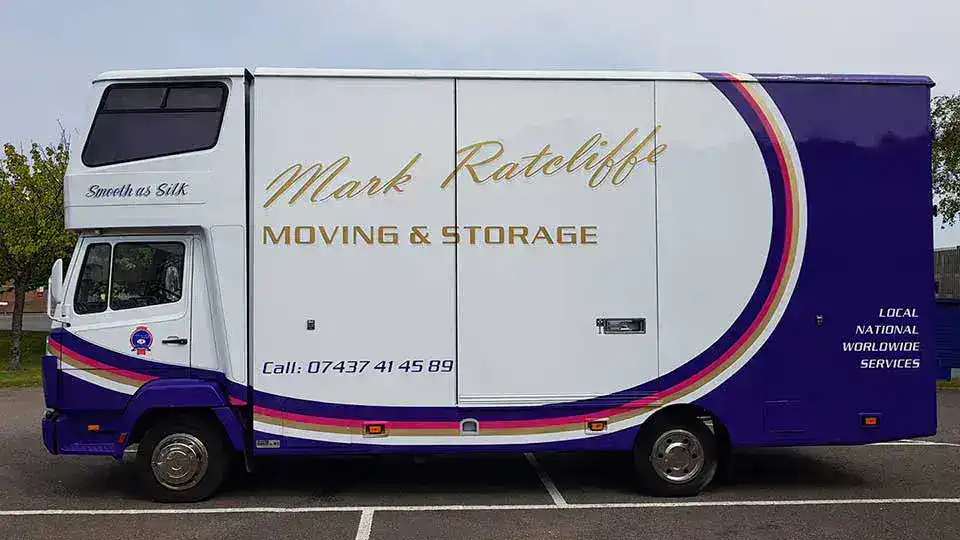
Cross-check the name too. The company you are contracting with should be the company named on the quote and on the bank details. If the website says one name, the quote says another, and the payee is a third, ask why before you transfer anything. For the record, we trade as Mark Ratcliffe Moving & Storage and the legal entity is EMV London Ltd, which is what appears on our paperwork and in our terms and insurance details.
“Fully insured” on a website means nothing whatsoever. Ask for the certificates — goods in transit, and public liability — as PDFs, by email, before you book. Any legitimate remover has them to hand and will send them without fuss. Then actually read them, because this is where most people stop too early.
Six things to look at on the certificate itself:
The insured name. It must match the company that is quoting you and taking your money. A certificate in the name of a different company, or an individual, or a firm the operator says they “work with”, does not cover your move.
The dates. Cover runs annually. Check the period of insurance includes your moving date, not just today’s date. An expired certificate is the most common thing people are sent, usually because nobody has updated the file rather than through malice — but it is still not cover.
The insurer and the broker. Both should be named. If you want certainty, telephone the broker on a number you find yourself rather than the one printed on the document, quote the policy number, and ask them to confirm the policy is live. Brokers deal with this request constantly and will not be surprised by it.
The limits. Goods-in-transit cover is typically written per vehicle or per load — often somewhere in the range of £25,000 to £100,000 — and public liability commonly at £2M or more. Compare the goods-in-transit limit against what your contents are actually worth. If your household is worth more than the limit, you need to know that before the lorry is loaded, not afterwards.
The exclusions and the excess. This is the part that decides real claims. Look for the treatment of owner-packed cartons, the excess you would pay per claim, any exclusion for items left in storage, and the deadline for notifying damage — which is often short, and is why the crew should walk the property with you before leaving.
Whether it is even the right kind of cover. Motor insurance is not goods-in-transit insurance. A trader who sends you a vehicle policy and calls it removals insurance either does not understand their own paperwork or is hoping you do not.
The most useful question is the simplest one. Ask, in writing: “if you drop my television, what exactly happens?” A real firm answers with a process — report on the day, photographs, claim reference, excess, timescale. A rogue answers with reassurance.
A VAT number is a small check that catches a specific problem, so it is worth thirty seconds.
HMRC runs a free “Check a UK VAT number” service on gov.uk. Enter the number from the quote or the website and it returns the registered business name and address for that number. Two things can go wrong. The number can be invalid, meaning it was invented. Or it can be valid but registered to a completely different business, meaning it was copied from somewhere — and a company copying another firm’s VAT number is very unlikely to be handling anything else honestly.
Understand what the check does and does not tell you, though. Not every legitimate remover is VAT registered; a genuinely small operator below the threshold may not be, and that is lawful. The problem is only when a firm displays a VAT number that does not check out, or charges VAT while not being registered to collect it.
While you are on the subject of tax, know the position on your own move. Domestic removals within the UK are VATable, so a UK house move should carry VAT and that is not a firm padding the bill. International removals are zero-rated for UK VAT, which is a statutory position rather than a discount anyone is granting you. A quote that treats these the wrong way round — or that offers to make the VAT disappear for cash — tells you what kind of business you are dealing with. Our international removals quotes reflect the zero-rating because the law requires it, not as a sales tactic.
A removal company needs somewhere to keep vehicles, blankets, cartons and, if it offers storage, your belongings. An address on a website is a claim about that. Verifying it takes about two minutes and it is the check that most reliably separates a business from a phone number.
Start with satellite and street-level imagery. A working removals depot looks like one: a yard, a building of some size, usually vehicles. If the postcode resolves to a terraced house, a flat above a shop, or an industrial unit with a completely different company’s name on it, you have your answer. Watch for virtual-office addresses too — a serviced-office block in a city centre is a mail-forwarding address, not a place a seven-tonne lorry lives.
Compare the address against the registered address on Companies House and against the one on the quote. They will not always be identical and that is fine — plenty of firms register at their accountant’s office — but the operating address should still be somewhere real.
Then ask to visit. This is the decisive test, particularly if any part of your move involves storage, because you are being asked to leave your possessions in a building you have never seen. Legitimate removers say yes; showing customers the depot is one of the easier parts of the job. A firm that will not host a visit, or that has a reason each time you ask, has told you what you needed to know. If you cannot travel, ask for a short video walk-through, or ask the surveyor to bring photographs.
Storage in particular deserves a specific question: is it your own facility or someone else’s, and if it is a third party’s, whose insurance covers the goods while they are there? The honest answer is easy to give. The evasive one is very informative.
We have two depots and no others: the main site at Lower Dicker in East Sussex on the A22, and Unit A2C, Redlands, Coulsdon, Croydon. Anything you read about us collecting from London, Norfolk, Wales, the Midlands or Scotland refers to collection runs, not depots — and if you would like to see either site, our about-us page has the details and you are welcome to come and look.
The quote is the last document you can verify before money moves, and it is the one that decides every argument afterwards. A real one is not a number in the body of an email. It is a document, and it contains all of the following.
The legal entity, address and company number, matching what you found at Companies House, plus a VAT number if the firm is registered. Your details and both addresses, written out properly, including any access notes the surveyor recorded.
The surveyed scope. A volume figure or a clear statement of what was included, the number of vehicles, the crew size, and the date. This is the anchor for everything else — a quote without a scope cannot be held to.
What is included, itemised. Packing tier, materials and quantities, dismantling and reassembly, protection standard, storage if any, and delivery. What is excluded, named explicitly — long carries, waiting time, parking suspensions, specialist items, customs paperwork on international work.
The price, stated as fixed or as an estimate, with VAT shown as a separate line, and the circumstances in which it could change. Payment terms: the deposit amount, when the balance is due, and the accepted methods. Ours is 25% on booking, protected under the BAR Advance Payment Guarantee, with the balance on completion.
Liability and insurance terms, including the limits, the excess, the treatment of owner-packed cartons, and the window for reporting damage. Cancellation terms, on both sides, including what happens if your chain collapses.
A named contact and a way to reach the office rather than one mobile number.
Read the terms as well as the quote — they are usually a separate document and they contain the parts that matter. If a firm has no written terms at all, there is nothing to enforce. You can compare all of this against ours: the terms and insurance page is public, and a written itemised quote comes back within 48 hours of survey through the online quote form. Our questions to ask a removals company covers what to raise at survey, and the guide to choosing a removal company covers how to weigh the answers.
Done in this order, the checks build on each other and you stop early if something fails.
One, get the names. Ask for the full legal company name, the company number, the VAT number if there is one, the BAR membership number if claimed, and the operating address. Ask by email, so you have it in writing. A legitimate firm supplies all of this in one reply without asking why.
Two, Companies House. Search the number, not the name. Confirm it exists, is active, and matches the trading name. Check the incorporation date against what the website claims. Click the directors and look at their other appointments for a chain of dissolved removal companies.
Three, the BAR directory. Search bar.co.uk directly. Confirm the membership exists and note the category.
Four, the VAT number on the gov.uk checker. Confirm it is valid and registered to the same business.
Five, the address. Satellite and street view. Does the depot look like a depot? Does it match the registered address, or is the difference explainable?
Six, the certificates. Goods in transit and public liability, as PDFs. Check the insured name, the dates, the limits and the exclusions. Ring the broker if the value at risk justifies it.
Seven, the reviews, read sceptically. Look at dates rather than star ratings. A cluster of glowing reviews inside one week, on a profile that is otherwise quiet, is worth more suspicion than a handful of ordinary complaints handled politely. Check whether the reviewed business name matches the company that quoted you — borrowed reputations are common. Ours are on the reviews page, at 4.9 out of 5 from more than 120 independent reviews, negatives included.
Eight, the quote. Read it against the list in the previous section, and read the terms attached to it.
If any step fails, ask about it before you conclude anything — paperwork genuinely does go out of date and small firms genuinely do get things wrong. What you are testing is the answer. A real business explains and sends the corrected document. The other kind gets irritated that you asked.
If you have already paid and something now looks wrong, act the same day. Contact your bank, ask about a chargeback or Section 75 if you paid by credit card, report it to Action Fraud, tell Trading Standards, and tell the BAR if BAR membership was claimed. If your belongings have already been collected and the firm has gone quiet, treat it as urgent and involve the police — our page on how the specific scams are run explains why speed matters in that situation.
We've been a family-run Sussex remover — the same name on the lorry as the name on the paperwork. Mark personally surveys the high-value and overseas moves; our crews are directly employed (not casual day labour) and trained at our own staff training centre, one of only a handful of UK removers with that facility on site.
Standard inclusions on every full removal: pad-wrap protection for every freestanding piece of furniture, removal-grade cartons, a written and itemised fixed-price quote with no surprises on the day, and the British Association of Removers' Advance Payment Guarantee protecting every deposit. The result, over the years and hundreds of moves, is a 4.9/5 review average across 120+ independent Google reviews.
Booking the survey takes ten minutes. Whether it's a one-bedroom flat across Eastbourne or a country house to overseas, the process is the same: in-home or video survey, written quote within 48 hours, deposit-protected booking, and a calm move day.
Free in-home or video survey, written fixed-price quote, BAR-protected deposit. Sussex’s family-run independent remover.
Ask the firm for its number and the exact name it is registered under, then search the member directory on bar.co.uk directly rather than through a link on the firm’s own site. Members appear; non-members do not. Note the category too — full membership carries the annual audit and the Advance Payment Guarantee.
That the company exists and is active, the incorporation date against any “established” claim, whether accounts are overdue, and the directors’ other appointments. A run of short-lived removal companies dissolved one after another under the same director is the most useful warning the register gives you.
Check the insured name matches the company quoting you, that the period of insurance covers your moving date, and that the insurer and broker are named. If the value at risk justifies it, ring the broker on a number you find independently, quote the policy number and ask them to confirm the policy is live.
Yes — HMRC’s free “Check a UK VAT number” service on gov.uk returns the registered name and address for any valid number. An invalid number was invented; a valid one registered to a different business was copied. Not every small firm is VAT registered, and that alone is not a problem.
Look at satellite and street-level imagery: a working depot has a yard, a building and vehicles. Compare it with the registered address at Companies House, then ask to visit. Legitimate removers say yes, and if any part of your move involves storage you should see the building before you commit.
The legal entity, company number and address; the surveyed scope with vehicle and crew numbers; itemised inclusions and named exclusions; the price with VAT shown separately; payment and cancellation terms; and the liability and insurance position including excess and claim window. Anything less cannot be enforced.