
A walk-through of what the crew actually does on the day, from the blanket stock on the lorry to the last wrap coming off in your new room.

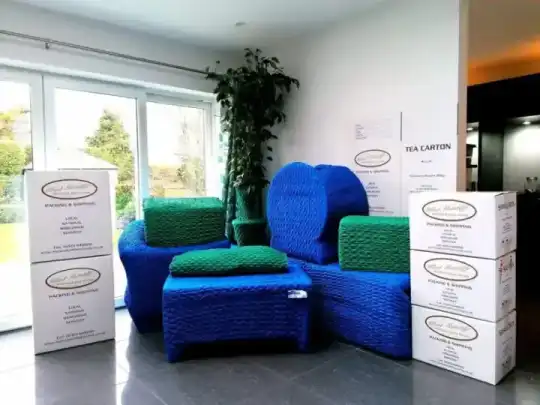
This is what pad wrap removals look like from inside the job. Not the theory of why blankets protect furniture, but the actual sequence our crew works through on a move day: how many blankets come off the lorry and where they were the night before, what happens in the three to five minutes a piece spends being wrapped, how the load is built so nothing shifts on the A22, what happens to a wrapped piece when it reaches your new hallway, and why none of it appears as a line on the quote.
If you want the wider explanation of what pad-wrap is and how it compares with bubble wrap, shrink wrap and the various things firms mean by “wrapped for transit”, that is covered in our full pad-wrap protection guide. This page assumes you already know it matters and want to see how it is done.
The first question people ask is whether removal blankets are included, and the second, once they have thought about it for a moment, is who used them last. Both are fair questions. The blankets on the lorry are ours, they cost you nothing on a full removal, and they were laundered after the job they went out on before yours.
They are industry-weight quilted moving blankets rather than household throws or the thin felt sold in hardware shops. The weight is the whole point: a heavy quilt absorbs a knock that a light one simply passes straight through into the wood. They are stitched with closed seams so the filling cannot migrate to one end and leave a bare patch across a table top, and they are held in place with webbing straps rather than tape, so nothing adhesive ever touches a polished finish.
Enough of them come out to do the whole house without rationing. A typical three-bedroom home has 40–80 pad-wrappable pieces once you count properly — beds, wardrobes, chests of drawers, sideboards, dining and coffee tables, sofas, armchairs, dressers, bookcases, desks — and the crew loads for that number before leaving the depot. Running short at eleven o’clock is exactly how the last few pieces end up travelling bare, so we would far rather bring blankets home unused.
The laundry is the part almost nobody asks about and the part that costs us most to sustain. Blankets come back from a job carrying whatever that job contained: soil off the shed contents, loft dust, hair from a house with three dogs, damp from a wet loading day. We run an in-house laundry system at our Lower Dicker depot so they are washed between jobs and dried properly before they go back onto a vehicle. A blanket that goes straight from a dusty house onto your dining table is a blanket that puts somebody else’s grit between the quilt and your veneer.
Watch a crew member wrap a chest of drawers and it looks quick, because the order of operations has been drilled until it is automatic. It is worth writing out, because every step in it exists to prevent a specific failure we have seen.
The drawers come out or get secured shut. Loose drawers travel forward under braking and either burst the front or shoot out on the carry, so the fronts are taped — with non-residue tape, applied to the join rather than to a polished face, so nothing is lifted when it comes off. Handles, latches, castors and anything else that protrudes get padded, because protrusions are what mark the piece next to them. Corner-board goes on where the corners are sharp, exposed or already tender. Any fragile detail — a gallery rail, a gilt edge, a glass door — is covered before the blanket rather than left to the blanket.
Then the quilt goes on, wrapped rather than draped, and a webbing strap goes round to hold it. The strap is what turns a covered piece into a wrapped one: a draped blanket slides off at the first doorway and leaves the corner bare exactly when it is being turned. Last comes the label, so the piece can be carried, stacked, driven and delivered without anybody having to lift a corner of the blanket to find out what is underneath.
Three to five minutes per piece sounds trivial until you multiply it. Fifty pieces is somewhere around three hours of crew time before a single item has been carried out of the door, and that is time we have costed into the job rather than time we are trying to save on the day. It is also why the crew splits: one pair wrapping ahead in the back rooms, another carrying and building the load, so the wrapping never becomes the thing everybody is waiting for.
A wrapped piece is only half the job. The other half is the stack, and this is where a lot of removal damage is actually created — not on the motorway, but by a load that was built loose and then spent an hour rearranging itself on the A22.
The principle is that a good load has no voids in it. Wrapped pieces go on in a planned sequence: heaviest on the floor, lighter above, flat faces against flat faces, wrapped corner against wrapped corner. Nothing hard ever meets glass or veneer directly — pad-on-pad or it does not go there. Gaps that would otherwise let a piece rock get filled with spare blankets or with cartons used as ballast, so by the time a tier is finished it is effectively one solid block.
Each tier is strapped as it is built rather than at the end. Straps run to the bulkhead and to the lashing points along the vehicle walls, and on the longer runs the lorry is configured with internal mooring points specifically so a load can be sectioned and tied rather than simply wedged. The reason for strapping as you go is practical: a tier that is only secured once the next one is stacked on top of it has already been unsupported for half an hour of loading, and that is when things move.
Nothing comes off in transit. A piece is not unwrapped at the depot, not unwrapped for a change of vehicle, and not unwrapped on a run that goes into storage or into a container. If a load is going overseas that matters even more, because the piece will pass through a road leg, a port, a sea leg and another road leg, and every one of those transitions is a chance for something to touch it. Our international removals service works the same way for that reason.
If you are comparing firms, this is a good thing to ask about specifically, because “we wrap everything” and “we build and strap the load in tiers” are different claims. The questions-to-ask guide covers what else is worth confirming before you book.
The piece comes off the vehicle still wrapped and stays wrapped for the whole of the difficult part — the tail lift, the path, the threshold, the turn at the bottom of the stairs, the landing, the doorway. Those are the moments that produce chipped corners, and they are precisely the moments a lot of firms have already taken the blanket off, because unwrapping at the tailgate makes the carry lighter and quicker.
Where each piece goes has been decided before it moves. The label put on at the wrapping stage names the destination room, so the crew is not stopping in your hallway asking. The piece is carried in, set down in the room and in the position you have chosen, adjusted if you change your mind, and only then does the wrap come off. That last moment is the first time you have seen the piece since it left the old house, and it is the point at which it is worth actually looking at it.
Please do look. If there is a mark, flag it while the crew is still on site: it gets photographed there and then and goes into a claim under our goods-in-transit insurance, which is straightforward on the day and considerably less so a fortnight later. Blankets come off, go straight back onto the vehicle, and go back to the depot laundry that evening for the next job.
Not everything travels under a blanket, and the unload reflects that. Cartons carry their own internal protection and come off in room order rather than wrapped — our fragile-packing guide explains what is inside them. Mattresses arrive in mattress covers, white goods in their own transit protection. Antiques, marble, art and glass-fronted cabinets come off pad-wrapped plus whatever additional protection they went on with, and corner-board is used on the building itself so a bulky piece cannot mark the doorways of a house you have just bought. The antiques-moving guide covers those pieces in more detail, and our white-glove service is the tier for contents where nothing is replaceable. Beds go back together before the crew leaves, because the one thing nobody wants to do at the end of a moving day is assemble a bed frame.
Half of what a wrapped piece can damage is not the piece. A blanketed wardrobe coming down a Victorian staircase is a heavy, bulky, slightly soft object being turned in a space that was not designed for it, and the thing it is most likely to mark is the house. So before anything moves, protection goes onto the building.
That means floor runners along every working route, carpet protection where the traffic will be heaviest, padding on the banister and newel post at the turn, and protectors on the door jambs of the rooms that the biggest pieces have to leave through. Corner-board goes on the tight corners, which on a lot of Sussex properties means the bottom of the stairs and the angle out of a narrow hall. The surveyor will have noted the awkward points at survey stage — a low door head, a half-landing with no room to pivot, a gravel drive that the tail lift will sink into — and the crew arrives knowing about them.
This matters at both ends and for different reasons. At the old house, if you are leaving a rental, marks on the walls and scuffs on the paintwork are a deposit conversation with a landlord who has an inventory. At the new house, the decoration is now yours, and the first scrape on a freshly painted stairwell is a memorable way to start. Neither is covered by anything to do with the furniture; both are avoided by ten minutes of preparation before the first item is lifted.
It is also the reason the crew asks to walk the route before starting. Working out where a three-metre sofa is going to turn is much cheaper on the walk-round than halfway up the stairs with two people holding it.
Everything described above costs us money. The blankets are industry-weight and we own a large stock of them. The laundry runs whether we like it or not. The wrapping itself is roughly three hours of crew time on a three-bedroom house, before anything has been carried anywhere. A firm that skips all three saves on materials, on overhead and on the length of the loading day, and can put a slightly lower number on the quote.
We include it anyway, for a reason that is less noble than it sounds: it is cheaper to prevent damage than to settle it. A chipped sideboard costs a claim, a repair, a return visit and a customer who tells people about it. The three hours cost us three hours. That arithmetic has never been close.
The second reason is about how quotes behave. If protection appears on a quote as an optional line, a proportion of customers will decline it to save money, and those are exactly the jobs that go wrong. Pricing it in removes the choice, which is the right outcome for everybody. So on every full removal we quote, pad-wrap on every freestanding piece, correctly sized removal-grade cartons, an itemised written quote and deposit protection under the British Association of Removers’ Advance Payment Guarantee are all in the headline figure. If another quote lists furniture protection as an add-on, the useful question is what the version without it actually involves.
What genuinely does cost extra, and appears as its own line: packing labour (a full pack on a three-bedroom home runs £450–£800, fragile-only £220–£340), specialist handling for pianos, antiques and marble, storage between completion dates, and customs handling on overseas moves. Book the free survey and you get all of it itemised.
Your side of it is simple: clear access. The crew works considerably faster with an unobstructed path to each piece, so moving lamps, plants and small decorative objects out of the way before they arrive genuinely shortens the day. Empty the drawers unless we have agreed otherwise at survey, and leave a clear space near each large piece so the blanket can be laid out and wrapped without the piece having to be shuffled first.
Wrapping well is a learned skill, which is why the crew matters as much as the blanket. Ours are directly employed rather than agency labour booked in for the day, and they are trained at our own staff training centre — on how to tape without marking a finish, how to label so the right piece ends up in the right room, and how to build a stack that will not move. A family-run Sussex remover can do that because the same people come back next week; a firm crewing from a day-rate pool cannot.
Mark personally surveys the high-value and overseas jobs, which is where the wrapping specification gets set: which pieces need archival tissue under the blanket, which need corner-board, which need crating rather than wrapping at all. That decision belongs at survey stage, not on the driveway on the morning. The 4.9/5 average across 120+ independent reviews is largely a record of days where those decisions were made early.
The method does not change with the size of the job. A one-bedroom flat across Eastbourne gets the same wrapping, the same strapping and the same unwrap-in-position as a country house going overseas; the only differences are the volume of materials and which crew is assigned. Booking a survey takes ten minutes and the written fixed-price quote follows within 48 hours.
Free in-home or video survey, written fixed-price quote, BAR-protected deposit. Sussex’s family-run independent remover.
Included. They are our blankets, they come out on our vehicle, and there is no line on the quote for them. You do not hire them, count them or return them — they go back to the depot with the crew at the end of the day.
Yes. We run an in-house laundry at the Lower Dicker depot and blankets are washed and dried before they go back onto a vehicle. Blankets pick up loft dust, garden soil and pet hair on every job, and none of that should end up between the quilt and your dining table.
By building the load in tiers with no voids and strapping each tier as it goes, rather than stacking everything and tying it at the end. Straps run to the bulkhead and to lashing points along the walls, gaps get filled with spare blankets or cartons, and wrapped faces sit against wrapped faces so nothing hard meets veneer.
No. It stays on through the tail lift, the path, the threshold, the stairs and the doorway, and comes off only once the piece is standing in the room and position you have chosen. Unwrapping at the tailgate makes the carry easier for the crew and is where a lot of chipped corners come from.
Never onto a polished face. Drawer fronts and doors are secured with non-residue tape applied to the join, and the blanket itself is held by a webbing strap rather than tape. Anything adhesive on a lacquered or veneered surface risks lifting the finish when it comes off.
You can, but we would rather use ours. Industry-weight quilts are heavier and stitched with closed seams so they take the weight of a loaded stack; household throws and hardware-shop felt compress, slide and let the filling migrate, which defeats the purpose at the moment it matters.
Tell the crew while they are still there. It gets photographed on the spot and goes into a claim under our goods-in-transit cover. Raising it on the day is far simpler for everyone than raising it a fortnight later once the room has been lived in.